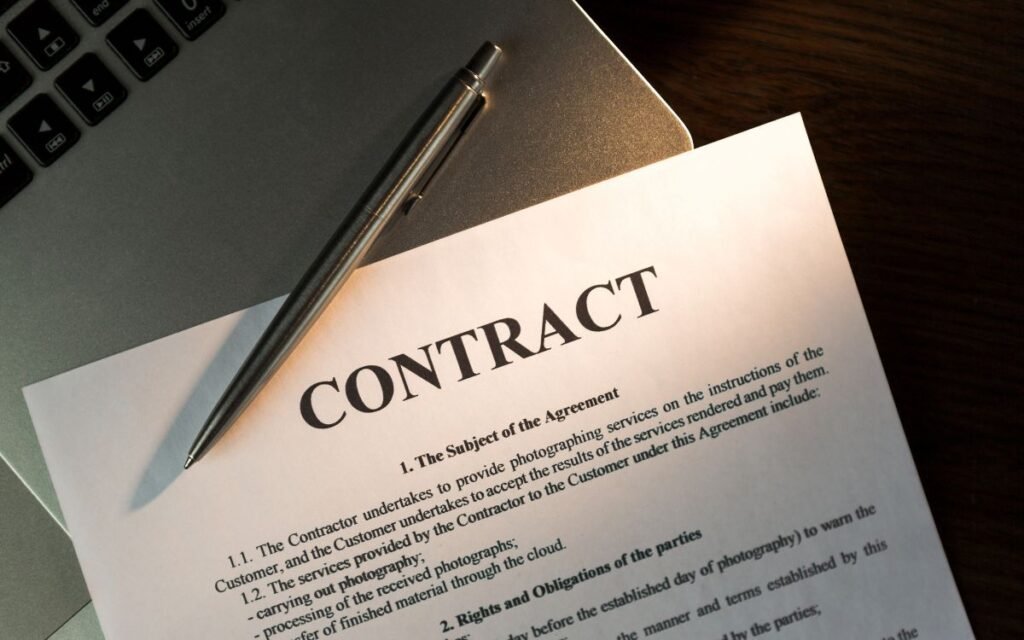
Every business relationship in Pakistan — whether a supplier arrangement, a partnership, or a service agreement — rests on the strength of the contract behind it. Yet many businesses still operate on verbal understandings or borrowed templates that were never written for their situation. When a dispute arises, those gaps become expensive.
Why a written contract matters
A well-drafted contract does more than record what two parties agreed. It anticipates what happens when things go wrong: late payments, defective goods, missed deadlines, or a party that simply walks away. A clear contract answers those questions before they turn into a courtroom argument, saving both time and legal cost.
Under the Contract Act, 1872, an agreement is enforceable when there is a lawful offer, acceptance, consideration, and the intention to create a legal relationship. But enforceability is only the starting point. The real value of a contract lies in how clearly it allocates risk between the parties.
Clauses that protect your business
Several clauses deserve particular attention when you review any commercial agreement:
Scope of work. Ambiguity here is the most common source of disputes. Define precisely what is being delivered, by when, and to what standard.
Payment terms. State amounts, due dates, and the consequences of late payment. A simple late-payment provision often prevents months of recovery litigation.
Termination. Set out how either party may exit, on what notice, and what happens to work in progress and outstanding fees.
Dispute resolution. Decide in advance whether disputes go to arbitration or the courts, and specify the governing jurisdiction. This clause alone can determine how quickly and cheaply a disagreement is resolved.
Confidentiality. Where sensitive commercial information changes hands, a confidentiality clause protects your position long after the contract ends.
Common mistakes we see
In our practice, the most frequent problems are not exotic legal issues — they are avoidable oversights. Businesses copy a contract from an unrelated deal without adjusting the terms. They leave key commercial points to a side conversation that is never recorded. They sign without reading the indemnity and liability clauses, which are often where the real risk sits.
Another recurring issue is the absence of a clear variation procedure. Commercial relationships evolve, and terms are frequently adjusted informally over email or in meetings. Without a clause governing how changes are made and recorded, those adjustments can become the subject of dispute.
When to involve a lawyer
Not every agreement needs bespoke legal drafting, but the higher the value or the longer the relationship, the greater the case for professional review. A short review before signing is almost always cheaper than litigation afterwards. If a counterparty presents you with their own contract, independent advice helps you understand which terms are standard and which are weighted against you.
At The Law Group, we help businesses draft, review, and negotiate commercial contracts that reflect their actual commercial intent — not a generic template. The goal is simple: an agreement that works when the relationship is going well, and protects you when it is not.
If you are entering a significant commercial arrangement, consider a review before you sign. It is one of the most cost-effective legal steps a business can take.